
How does the TikTok algorithm work?
In today’s interconnected world, we know that what we see on social media has a significant impact on our behaviour and shapes our ideas. The case of Alana Anisio Rosa illustrates this: the 20-year-old Brazilian woman was stabbed by a man after she rejected his advances. This tragedy took place against the backdrop of a recent trend in which men simulate punching, kicking and stabbing women who reject their romantic advances. In this article, we will analyse the role of the TikTok algorithm and its implications.
First, let’s look at how the TikTok algorithm works. It begins by taking into account initial settings such as the user’s country, language and the categories they are interested in. It then personalises the videos shown on the “For You” page based on the content the user spends the most time watching and their preferred topics. Finally, and most importantly, it relies on the user’s interactions with videos: what they like and how long they spend watching videos on a given topic. All of this allows it to offer the videos best suited to their preferences.
This means that users feed their own algorithm: the more time they spend on videos about misogyny, the more the algorithm will push similar content. Research by UCL, the University of Kent and the Association of School and College Leaders (ASCL) showed that after setting up a boy’s profile showing interest in themes such as managing loneliness, self-improvement, male victimhood, or masculinity and power, “the TikTok algorithm was presenting four times as many videos with misogynistic content such as objectification, sexual harassment or discrediting women” after only five days. TikTok pushes videos that blame women and feminism for men’s loneliness, targeting the vulnerabilities of boys and young men. We should bear in mind that the younger people are when they are exposed to content, the greater its impact on their beliefs and their view of society. Young people are easily influenced, and it becomes dangerous when online ideologies are normalised and carried into schools.
Furthermore, misogynistic content provokes strong negative emotions such as anger and indignation, so people react, comment and stay longer on the videos. In other words, this type of content quickly generates a large number of interactions, both positive and negative, which the algorithm interprets as “engaging”, so it keeps pushing it to other users. On top of this comes gamification, which consists of presenting this kind of content in “humorous” formats such as memes and viral audios. This distorts younger users’ moral compass: for them, violence becomes a game.
What content does TikTok show to teenage girls and boys?
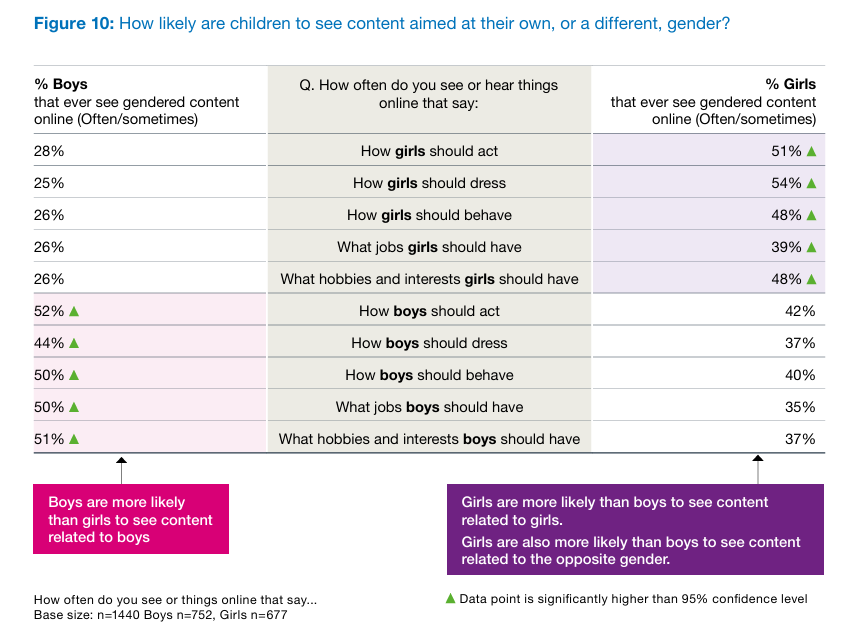
A 2026 study by Plan International shows how different TikTok content is depending on whether the account belongs to a girl or a boy, and it only takes about twenty minutes for these differences to appear. Plan International created six fake accounts of users aged 13 to 16. The girls’ accounts were quickly shown beauty standards and luxury lifestyles, while the boys’ accounts received content about wealth, strength, emotional isolation and misogyny.
A 2024 study by Dublin City University confirms this pattern: all the male accounts were shown masculinist content in less than 23 minutes, even when they only showed interest in general topics. It is alarming to realise that boys do not even need to look for this content, because the algorithm brings it to them. In addition, young boys and girls naturally want to belong to a group, and since TikTok creates communities, it gives young people a way to share their interests and discuss them. But like all platforms that bring people together, it can drift, and this has led to the rise of the “manosphere”: a network of online communities and influencers that promote a dominant vision of masculinity and present women and feminism as the cause of men’s problems.
How do content creators spread misogyny on TikTok?
Content creators are the leaders of these communities, and they play a key role: they adapt their videos to what the algorithm rewards and seek attention, because their income depends on how well their videos perform. As previously said, provocative content generates the most interactions. It keeps happening because making such videos creates a lot of attention for the viewers and rewards the content creator.
Influencers have a lot of impact on young people especially because at that age teens are still searching for what resonates with them, thus normalized misogyny that often hides behind humour is dangerous because it makes it hard to denounce. It is reinforced by misogynistic rap lyrics, which often trend simply because the song is the latest hit, and according to Weitzer and Kubrin, whose 2009 analysis found that 67% of 1990 songs sexually objectify women and it does not get better nowadays. If we think about it, this mindset could create a divided society in which women see men as a threat, while men blame women for their problems and continue to oppress them. The perfect example is the fake assault trend mentioned at the beginning of this article: online, men pretend to hit or stab women for “laughs” and views, while in real life, Alana Anisio Rosa was stabbed for saying no. The trap is that young girls often adopt these ideas too. This can be explained by internalised misogyny, a phenomenon in which women subconsciously absorb society’s sexist attitudes and gender stereotypes and project them onto themselves and other women, because these ideas have become so normalised.
However, creators who want to fight this have a new lever: Generative Engine Optimization. GEO is the practice of structuring content so that AI tools like ChatGPT or Google’s AI Overviews pick it up and quote it in their answers. More and more people now ask their questions to AI assistants, and platforms like Google are pushing AI-generated answers to their users on a massive scale. These tools tend to pick up content that is well sourced and clearly structured rather than provocative videos. This could give creators a real chance to be heard, as long as they back their content with facts and sources. Doing so gives egalitarian content credibility and reliability, and can push it to the top of AI-generated answers. But we must keep in mind that this strategy is double-edged, because GEO can also be used to manipulate AI and spread hateful and misogynistic ideas, a practice sometimes called “data poisoning”.
In conclusion, Alana Anisio Rosa’s story shows that what happens on social media can quickly escalate in real life.The algorithm promotes provoking content that is shared and reproduced by certain content creators to generate engagement and views. Hidden behind the “humour” excuse it is being normalized which leads to real life tragedy like Alana’s even though she thankfully survived the attack. It is important to mention that the algorithm does not create misogyny it amplifies it thus the responsibility being on the platform as well as the influencers and the users.
sources:
Social media algorithms amplify misogynistic content to teens | UCL News