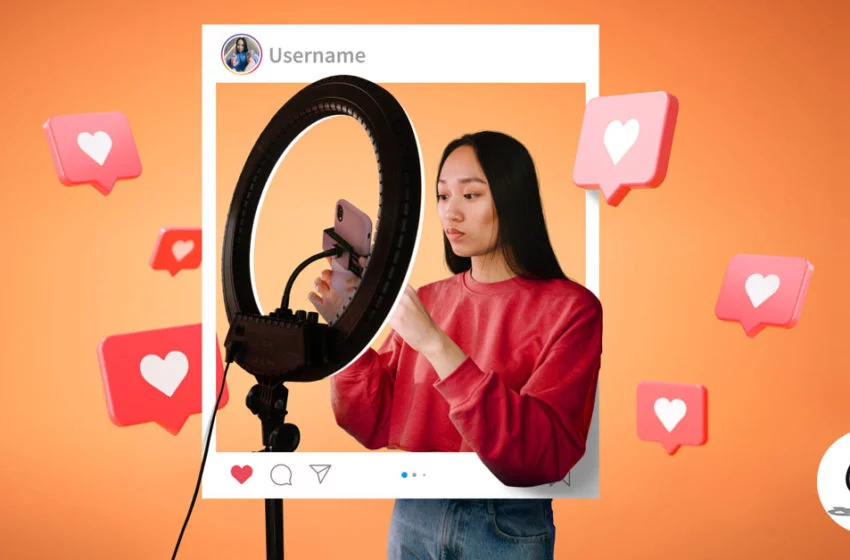
Social Media and Fast Fashion: The Rise of Overconsumption
By bouchemlaamsellakhdar
18 March 2026 · 14 vues
Share this article
In the digital era we live in, social media has taken a great place in our daily lives and influences many of our consumption choices. The constant exposure to content has made a lot of changes in several industries, particularly the fashion sector. Platforms like Instagram, Tiktok and Youtube are becoming essential digital marketing tools for brands who now rely heavily on them to reach their consumers. Social media and fast fashion have grown rapidly in recent years. This leads us to ask ourselves: How does social media contribute to the rise of fast fashion. This article presents how trends and influencers contribute to the acceleration of clothing consumption.
WHAT IS FAST FASHION IN SOCIAL MEDIA?
Most consumers have, at some point, purchased clothing items simply because they were trending online. This can reflect how much our consumption habits have accelerated in recent years. This acceleration is largely influenced by social media fast fashion trends. According to the Merriam-Webster dictionary, fast fashion is an approach to the design, creation, and marketing of clothing that emphasizes making fashion trends quickly and cheaply available to consumers. This model has become a major issue that harms both the environment and the workers. According to the United Nations Environment Programme, the fashion industry is responsible for up to 8% of global carbon emissions. Brands such as Zara and H&M have accelerated this model by rapidly producing and promoting new collections on social media. These brands use social media fast fashion strategies to push trends more quickly than ever before.
THE ROLE OF INFLUENCERS AND TRENDS
Social media has given millions of people a platform to express their lifestyles and passions. However, it has also permitted the rise of influencer marketing which is becoming a key digital marketing strategy for brands who collaborate with content creators to promote their products. For example, similar strategies can also be seen in brand–athlete partnerships in sports marketing, where collaborations strongly influence consumer behavior.Read more here.Social media fast fashion promotion is largely driven by influencers.Many of those influencers, and sometimes without even realizing it, contribute to overconsumption by constantly showcasing new clothing items and trends.
This situation started with Youtube haul videos where creators showed the results of their large shopping sprees. Today, this has expanded to every platform such as Tiktok where algorithms play an enormous role in content distribution. Social media fast fashion content is amplified by algorithms. Those algorithms prioritize highly engaging content and help promote videos featuring clothing hauls such as “Get ready with me” or “Outfit of the day” to large audiences.
As a result, social media accelerated trend cycles, turning some items into must-haves in the span of one night. Digital marketing strategies in the fashion industry rely on this rapid diffusion of trends to encourage more frequent purchases. However, when those trends die down, those clothes are often thrown away contributing to waste and environmental damage. According to the United Nations Environment Programme:
SOLUTIONS TO SOCIAL MEDIA AND FAST FASHION IMPACTS
This situation can make us ask ourselves: can we change this pattern? While social media has contributed to the rise of fast fashion, it can also promote more sustainable approaches.
The adoption of better practices could strongly reduce the impact of digital marketing on consumer behavior. For example, influencers could promote ethical influencer marketing by promoting sustainable brands and practices. Alternatives such as upcycling , rental and thrifting are becoming increasingly popular.
In addition to that, if users engage more with content that is mindful of sustainability, algorithms on platforms like TikTok and Instagram will begin to prioritize this type of content and this could slowly reshape online trends and encourage responsible consumption.
CONCLUSION
Social media and fast fashion are strongly connected in today’s digital environment, enabling influencer marketing and accelerating our way of consuming clothes through powerful digital marketing strategies. However, these same tools can also be used to promote sustainable alternatives. Maybe one day, both marketers and consumers will use digital platforms in a more responsible and sustainable way, prioritizing quality over quantity in their choices.
Bienvenue sur ce site fièrement réalisé par les étudiants de HEC Montréal. Nous utilisons des technologies telles que les fichiers témoins. Le fait de consentir à ces technologies nous permettra d'obtenir et d'analyser votre comportement de navigation dans le seul et unique but d'améliorer notre site dans un contexte pédagogique et bien entendu non commercial. Bonne lecture !
Fonctionnel Always active
Le stockage ou l’accès technique est strictement nécessaire dans la finalité d’intérêt légitime de permettre l’utilisation d’un service spécifique explicitement demandé par l’abonné ou l’internaute, ou dans le seul but d’effectuer la transmission d’une communication sur un réseau de communications électroniques.
Préférences
L’accès ou le stockage technique est nécessaire dans la finalité d’intérêt légitime de stocker des préférences qui ne sont pas demandées par l’abonné ou l’internaute.
Statistiques
Le stockage ou l’accès technique qui est utilisé exclusivement à des fins statistiques.Le stockage ou l’accès technique qui est utilisé exclusivement dans des finalités statistiques anonymes. En l’absence d’une assignation à comparaître, d’une conformité volontaire de la part de votre fournisseur d’accès à internet ou d’enregistrements supplémentaires provenant d’une tierce partie, les informations stockées ou extraites à cette seule fin ne peuvent généralement pas être utilisées pour vous identifier.
Marketing
Le stockage ou l’accès technique est nécessaire pour créer des profils d’internautes afin d’envoyer des publicités, ou pour suivre l’internaute sur un site web ou sur plusieurs sites web ayant des finalités marketing similaires.