
Find out how brands use AI-generated content and how it affects a brand’s authenticity. Learn from NB Liquor’s AI-generated advertisement.
The Rise of AI-Generated Marketing Content
Yesterday, whilst going through Instagram, I saw a photo of a burger. It was pretty much spot on in terms of perfection, with a very soft bun and all the toppings in the right place. There was just something wrong about it, and it quickly became apparent that it was AI-generated. That got me thinking: why on earth would any business use AI to create content that is so generic and lifeless?
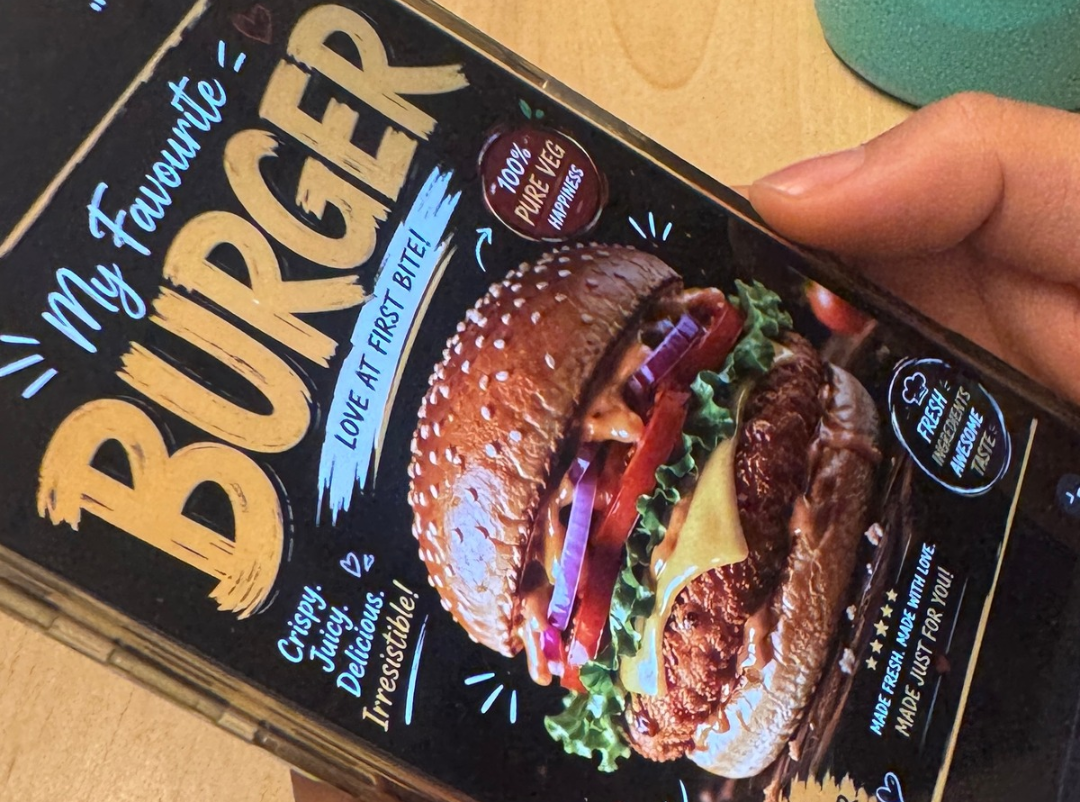
This type of content is often called “AI slop”, and it is showing up more and more in local business advertising, especially in the restaurant industry. Of course, I understand that not every business can afford professional photography. Still, I can’t help but wonder if every restaurant starts relying on AI-generated visuals, will all food start to look the same?
Ultimately, the challenge today isn’t whether brands should use generative AI. It is more about how they can integrate it into their marketing strategies and tactics without sacrificing authenticity and consumer trust.
How Do Businesses Use Generative AI in Marketing?
By definition, generative AI is a tool that creates content such as text, images, and videos by identifying patterns from large amounts of existing data. For instance, tools like ChatGPT rely on large language models (LLMs) to understand language patterns and generate natural-sounding responses.
In marketing, businesses use generative AI to plan, execute, and optimize their activities. Generally, their applications fall into two categories:
1. Technical and strategic applications
- AI used for data analysis: AI helps to identify patterns in consumer behavior and market trends.
- AI used for audience segmentation: AI can segment audiences by grouping consumers who share similar characteristics, interests, or buying habits.
- AI used for campaign personalization: AI personalizes campaigns by tailoring marketing messages to specific audiences.
- AI use for task automation: AI automates tasks by handling repetitive activities like responding to emails.
- AI use for keyword optimization: AI improves keyword optimization by finding relevant keywords that boost search engine visibility.
2. Creative applications
- AI for social media content: AI can help with social media by generating captions, suggesting post ideas, and creating content calendars.
- AI for blog articles: AI can help draft blog articles, create outlines, and write website content.
- AI for product descriptions: AI can create or improve product descriptions for online stores.
- AI for advertising visuals: AI can produce images and promotional materials for advertising.
- AI for video production: AI can help with video scripts, storyboards, and visual content.
Although these tools are quick and efficient, we must remember they are machines and lack a human touch, meaning they don’t truly understand a brand’s identity or its customers the way a human does. This is why human judgment is crucial.
Why Are Brands Using AI-Generated Content?
Brands are so eager to adopt generative AI all comes down to its speed and cost. What once took teams of employees, photographers, creative directors, and marketers can now be produced in just a couple of minutes. Plus, it’s free, meaning you don’t have to pay anyone, and you keep all the rights.
In an interview with La Presse, Isabelle Maheux, coach at Pivotte & Stratt Agency, explains that for small businesses, especially those in the food industry, these time and cost savings can make a significant difference, because creating advertisements for multiple platforms like Instagram, Facebook, and TikTok can be time-consuming for businesses with limited resources.

However, if every restaurant starts producing its advertisements using the same tools, what will happen to what made each one different?
How Does Generative AI Affect Brand Authenticity and Consumer Trust?
Consumers can smell inauthenticity a mile away especially Gen Z who expect transparency and values alignements from brands they buy from.
– Ana Andjelic, brand strategist and author of The Business of Aspiration
As AI-generated content becomes more common, consumers are starting to value authenticity more than ever. They want brands that feel genuine and that reflect the products and experiences brands actually offer. In marketing, authenticity is the ability to build connections with customers by making them feel understood. Basically, it’s the feeling that you can trust the brand.
However, the issue goes beyond the impression an advertisement creates. The brand’s simple use of AI advertisements can also communicate its values and priorities. As we all should know by now, AI comes with high environmental costs. In this sense, authenticity is not only reflected in what a brand communicates, but also in the choices it makes behind the scenes.
How can AI-generated marketing content weaken brand authenticity?
- Lack of human connection: The content feels impersonal, making it harder for brands to build relationships with customers.
- Limited originality: Because AI tools rely on existing data, the content they create won’t make a brand stand out.
- Weak storytelling: AI doesn’t know how to capture the emotions and the personality behind a brand.
- Misleading visuals: AI-generated images can create unrealistic and sometimes uncanny visuals.
If customers can’t tell what is real, they have little to no reason to believe anything the brand says. This uncertainty weakens trust and makes the brand harder to believe. And once that trust is weakened, rebuilding it becomes much harder. In the end, authenticity is the final test a brand must pass in marketing.
Why Did NB Liquor’s AI-Generated Holiday Ad Spark Public Backlash?
In December 2025, the Société des alcools du Nouveau-Brunswick (ANBL) released a completely AI-generated holiday ad. The aim of the ad was simply to get people to go and pick up some ‘extra holiday cheer’. It was a 15-second video of friendly neighbours turning up at a door with bottles of liquor that had absolutely nonsense on them.
Of course, the ad quickly sparked controversy among New-Brunswick’s creatives. Robert Gray, a film and creative director at the University of New Brunswick and co-owner of a local company, called out the ad in an interview with Global News, saying it was lazy and an insult to the province’s creative community. He even joked about going to party in Nova Scotia instead.
In addition, Pierre-Luc Arseneau, a filmmaker who worked on ANBL’s previous Christmas campaign, also expressed his disappointment to Global News. He confided that he was sad to see all his hard work and effort down the drain. He said he felt like AI had replaced all his previous work.
However, ANBL defended its decision. Their excuse: they regularly work with agencies that also use AI in their creative processes, and that they were only experimenting with new techniques to reduce the advertising costs.
So, what went wrong?
Thus, the controversy wasn’t only about using AI to produce an advertisement. As a Crown corporation, ANBL is held to higher standards than a privately owned or small business. In reality, they ought to hold a high responsibility when it comes to supporting the local economy and local talent. So, by overlooking this responsibility, they are sending the message that they valued the cost of the ad, over its community.
Rather than going in and creating the whole ad with AI, they could have taken a hybrid approach. They could have used AI to generate some of the ideas and to do some of the editing, and then have local filmmakers, local photographers, and local actors to actually connect with their customers. That would have given them the benefit of AI without losing the human element.
AI-Generated vs. Human-Made Marketing Content: Key Differences
Human-made and AI-generated both offer different advantages. The most effective way to achieve marketing goals isn’t necessarily to choose one over the other. It is about combining AI’s efficiency with human judgment.
| Criteria | Human-made content | AI-generated content |
|---|---|---|
| Production cost | Generally high | Generally low |
| Production speed | More time-consuming | Faster |
| Creativity | More originality and innovation | Only based on patterns from existing data |
| Authenticity | Reflects human perspectives and emotions | Needs human guidance |
| Brand identity | Strong understanding | Needs human guidance |
| Scalability | Limited by time and resources | Easier to scale |
| Consumer trust | Can build personal connections | Depends on their transparency |
Frequently Asked Questions About Generative AI in Marketing
It refers to generic, low-quality content that lacks originality and attention to detail and is created by artificial intelligence.
When brands rely too much on AI-generated content, they start to look generic and lose their authenticity. Plus, customers can tell when content isn’t real, making it harder for them to trust and connect with the brand.
By cutting corners instead of supporting local talent, ANBL came across as out of touch and missed the mark on serving its community.
Businesses can stay authentic by using AI mainly to assist humans, such as for ideas and repetitive tasks. Additionally, maintaining customer trust means being honest about its use and minding its environmental impact.
Neither is necessarily better than the other. While humans write with real feelings and originality, AI works much faster and can make more content.
References
- BDC. (2024, September 4). L’IA pour les ventes et le marketing. https://www.bdc.ca/fr/articles-outils/technologie/intelligence-artificielle/ia-pour-ventes-et-marketing
- Breau, M. (2025, December 5). Une publicité d’Alcool NB générée par l’intelligence artificielle dénoncée. Radio-Canada. https://ici.radio-canada.ca/nouvelle/2211355/ia-publicite-polemique-culture-nb
- Centre de la sécurité des télécommunications Canada. (2024, August 30). Voici 9 façons de repérer du contenu créé à l’aide de l’intelligence artificielle. Pensez cybersécurité. https://www.pensezcybersecurite.gc.ca/fr/ressources/voici-9-facons-reperer-contenu-cree-laide-lintelligence-artificielle
- Dauphinais-Pelletier, C. (2026, November 7). Indigestion de plats générés par l’IA. La Presse. https://www.lapresse.ca/affaires/chroniques/2026-11-07/restaurants-et-publicite/indigestion-de-plats-generes-par-l-ia.php
- Farley, S. (2025, December 4). Province pauses AI commercial from N.B. Liquor after negative reception. CBC News. https://www.cbc.ca/news/canada/new-brunswick/nb-liquor-ai-commercial-9.7003525
- Gruson, F. (2024, April 15). L’IA pour la création de contenu :avantages et limites. RabLab https://rablab.ca/blog/ia-creation-contenu-avantages-limites/
- Haleem, A., Javaid, M., Qadri, M. A., Singh, R. P., & Suman, R. (2022). Artificial intelligence (AI) applications for marketing: A literature-based study. International Journal of Intelligent Networks, 3, 119–132. https://doi.org/10.1016/j.ijin.2022.08.005
- Hari, H., Sharma, A., Verma, S., & Chaturvedi, R. (2025). Exploring ethical frontiers of artificial intelligence in marketing. Journal of Responsible Technology, 21, 100103. https://doi.org/10.1016/j.jrt.2024.100103
- Huang, M.-H., & Rust, R. T. (2021). A strategic framework for artificial intelligence in marketing. Journal of the Academy of Marketing Science, 49(1), 30–50. https://doi.org/10.1007/s11747-020-00749-9
- Kumar, V., Ashraf, A. R., & Nadeem, W. (2024). AI-powered marketing: What, where, and how? International Journal of Information Management, 77, 102783. https://doi.org/10.1016/j.ijinfomgt.2024.102783
- Lau, R., & Lapointe, S. (2025, December 3). NB Liquor’s AI ad has local creative industry calling it ‘lazy’ and ‘an insult’. Global News. https://globalnews.ca/news/11557633/nb-liquor-ai-holiday-ads/
- Lavallée, M.-P., & Dianhka, Y. (2026, May 21). L’intégration de l’IA en marketing… trucs et astuces afin de bien l’intégrer et ne pas se faire attraper. La note marketing. https://lanotemarketing.uqam.ca/2026/05/21/intelligence-artificielle-en-marketing/
- Trottier, L. (2026, August 8). L’usage de l’IA générative à des fins de marketing fait réagir au Yukon. Radio-Canada. https://ici.radio-canada.ca/nouvelle/2274217/intelligence-artificielle-marketing-yukon-polemique