

Have you ever bought something because of an influencer? If you are wondering how to measure influencer marketing ROI, this question matters more than you think. According to the 2026 Sprout Social Influencer Marketing Report, 86% of consumers make at least one purchase per year inspired by an influencer.
For brands, proving how much money a campaign brought in, is much harder. A post can collect thousands of likes and still sell very little.
This article explains how to measure Influencer Marketing ROI. More specifically, what ROI means, which numbers to follow, and how a creator’s engagement rate can guide a brand’s choices.
What is Influencer Marketing?
An influencer is a person who has built a large and loyal audience on social media, such as Instagram, TikTok or Youtube, and whose opinions are trusted by his audience. Influencer marketing is when a brand rewards these creators, with money, free products or a commission, to present its products to their followers.
Do Influencers really make people buy?
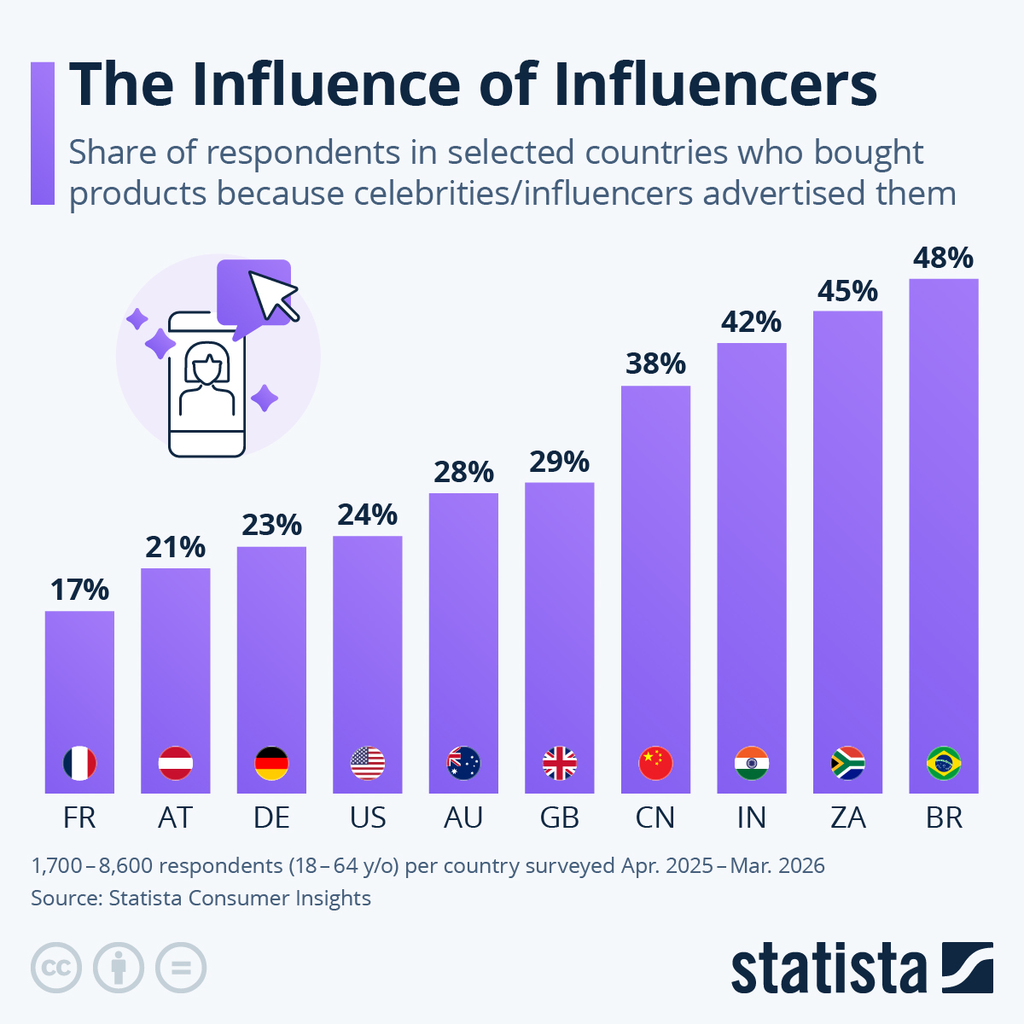
The Statista chart ” The Influence of Influencers” shows the share of people in ten countries who bought a product because a celebrity or influencer advertised it.
- Lowest in Europe: 17% in France and 23% in Germany.
- Middle: 24% in the United States and 29% in the United Kingdom.
- Highest in emerging markets : up to 48% in Brazil.
How can Sprout Social find 86% while Statista finds 24% in the United States? The two surveys do not ask the same question. Sprout Social counts any purchase inspired by an influencer over a year while Statista asks whether people bought something because an influencer advertised it, a stronger statement that many consumers do not like to admit.
So influencers do have an effect, but it’s not always direct, and that’s why ROI is tricky to measure.
What is Influencer Marketing ROI?
ROI stands for Return On Investment. It compares what a campaign brought in with what it cost. As Sprout Social’s guide to influencer marketing ROI shows, it is also the number that helps a marketing team justify its budget. Here is the formula :
If the result is positive, the campaign earned more than it cost. The cost should include everything such as the creator’s fee, the free products, the shipping and time spent managing the campaign.
Why is it hard to Measure Influencer Marketing ROI?
The hardest part is knowing which sales came from the influencer.
Someone may see a video today and buy two weeks later after a Google search, and the influencer receives no credit.
The Influencer Marketing Benchmark Report 2026 shows how brands deal with this today:
- Brand awareness is the most popular measure of success, chosen by 55.1% of respondents.
- Promo codes are the most common tracking tool (45.9%), followed by affiliate links (26.0%).
- Yet 65.9% of respondents expect their investment to pay off within one month.
There is a clear contradiction. Brands expect more sales but mostly measure awareness.
Which KPIs should you track to Measure Influencer Marketing ROI ?
A KPI (Key Performance Indicator) is a number that shows whether a campaign is reaching its goal. Later’s article on measuring influencer marketing group them by objective:
| Campaign goal | KPIs to follow | What they tell you |
|---|---|---|
| Awareness | Reach, impressions, video views | How many people discovered the brand |
| Engagement | Likes, comments, shares, engagement rate | How interested the audience was |
| Traffic | Link clicks, website visits | How many people wanted to learn more |
| Sales | Promo code uses, conversions, revenue | How much money the campaign brought in |
Reach is the number of different people who saw the post, while impressions count every display, including repeat views. A conversion is the moment a viewer takes the action the brand wants, usually a purchase.
Engagement rate : The Example of Spencer Barbosa
The Engagement Rate measures how much an audience interacts with a creator’s content:
Some tools also count shares and saves.
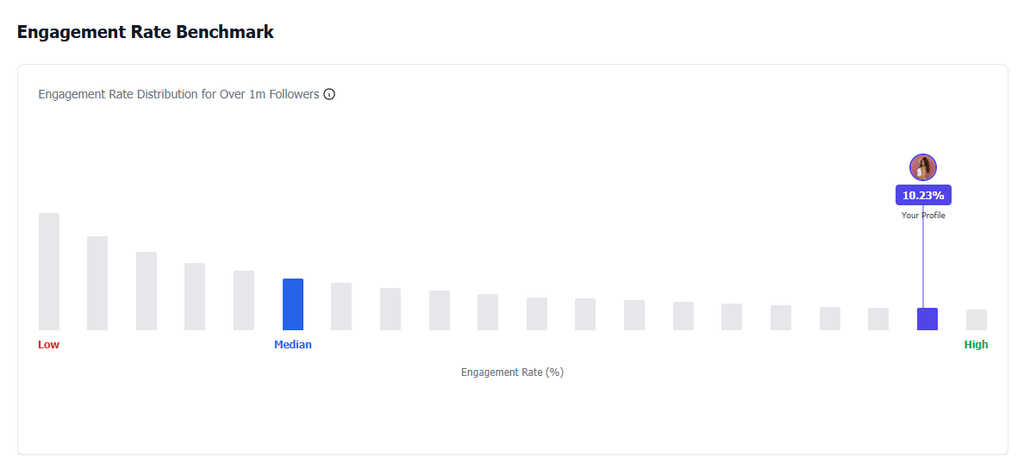
Spencer Barbosa is a Canadian influencer known for her lifestyle content and her message of body positivity. According to the Social Cat engagement rate calculator, her Instagram account had an engagement rate of 10.23% in November 2026, much higher than the median for accounts with more than one million followers.
Engagement usually drops as an account grows, so her large and active community suggests real trust. For a fashion or beauty brand aligned with body positivity, this trust matters more than having a lot of followers, even if it does not guarantee sales.
How can a brand track the sales an Influencer generates?
It is best to combine several methods:
- Personal promo code (for example, SPENCER15): simple, but codes can often end up on coupon websites.
- Tracked links in the influencer’s bio or story, showing how many visitors and purchases came from them.
- Affiliate links which pay the influencer a commission on each sale.
- A question after checkout, such as “How did you hear about us ?”, to find the people who used no code or link.
How to plan an Influencer Marketing campaign that brings real ROI?
Most brands think about ROI at the end of a campaign, when it is often too late to measure it properly. In my view, measurement should be planned from the start.
The brand first needs SMART goals, meaning goals that are:
- Specific
- Measurable
- Achievable
- Relevant
- Time-bound
“Sell 200 products with a creator’s code in one month” can be measured. “Make the brand more popular” cannot.
This also answers the contradiction seen earlier in the Influencer Marketing Hub report. If brands expect quick sales, their goals and KPIs should be about sales, not only awareness.
The Youtube video of Influencer Hero tells the same idea: setting SMART goals and KPIs is the first step, and unique codes or affiliate links have to be ready before the posts go live.
Without this planning, you’ll get statistics, but you won’t really know if the campaign worked.
FAQ
Do influencers really make people buy?
Yes, but less directly than we think. Sprout Social says 86% of consumers buy something inspired by an influencer each year, while Statista shows that fewer people admit buying because of an ad.
Is a bigger influencer always better?
Not really. What matters is how involved the community is. Spencer Barbosa’s high engagement rate shows that trust counts more than followers.
What is the easiest way to track sales from an influencer to measure influencer marketing ROI?
A personal promo code or an affiliate link. It is simple to set up and shows how many sales each creator brought.
When should a brand measure the influencer marketing ROI?
Not the day after the post. People often buy a few days or weeks later, so it is better to wait before judging a campaign.
Conclusion
In the end, influencers do influence what people buy, but their impact is often indirect. To measure influencer marketing ROI, it starts with a clear goal, then continues with the right KPIs and tracking tools, and ends with a calculation of cost and sales. The influencer Spencer Barbosa shows that real engagement can matter more than follower counts.
Sources
- Sprout Social, Influencer marketing statistics to know in 2026
- Sprout Social, Influencer marketing ROI guide
- Statista, The Influence of Influencers
- Later, How to Measure Influencer Marketing: Metrics, ROI, Tools
- Influencer Marketing Hub, Influencer Marketing Benchmark Report 2026
- Social Cat, Instagram engagement rate calculator: spencer.barbosa
- Influencer Hero, How to Launch a High-ROI Influencer Marketing Campaign (Beginner to Pro Guide), YouTube, 2025