
How to Find and Evaluate Micro-Influencers: A Step-by-Step Guide for Small Brands
Why is it hard to find the right micro-influencer?
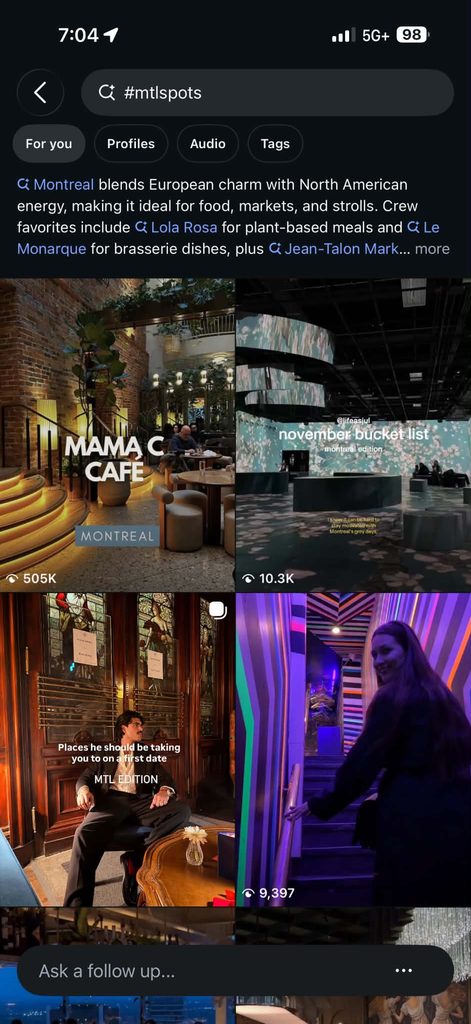
For a small business, the problem is not a lack of creators, but the fact that there are too many of them (small ones). For example, a search like #mtlspots on Instagram shows thousands of posts from different accounts each recommending different spots. Choosing the wrong influencer can make you lose money and even hurt the brand’s image if the job isn’t done right. This represents a big risk for a business that doesn’t have too much budget to put on advertising.
Also, fake followers make this choice harder. In 2019, a study by the University of Baltimore looked at ten thousand influencers and found that at least 15% of their followers were fake. According to the study, this problem cost brands more than a billion dollars for only that year (Wilson, 2019).
This is why, in this article, I explain step by step how to find micro-influencers and, most importantly, how to check them and review their profile before paying anything to anyone.
Key takeaways and first steps
- You should start by looking at your own customers and followers. Then, you should conduct a search for local hashtags. You can also use tools like Instagram’s creator marketplace and TikTok One to help you.
- You must choose creators based on what kind of person follows them and how real their likes and comments are, not on how many followers they have. Quality is better than quantity.
- People trust an influencer more when the product matches what they usually post about. For example, a gym influencer posting an ad about proteins.
- Before going forward, check their comments (how the audience feels), where their followers live, how fast they gained followers, whether they label their sponsored posts, etc to validate authenticity (You do have to get the creator’s data for this point).
Evaluating a Micro-Influencer
It resembles looking at someone’s references, but here, the “employee” you are going to hire will represent your brand in front of thousands of people. Therefore, you must choose wisely.
Key elements:
| Term | What it means | Example |
|---|---|---|
| Micro-influencer | A creator with about 10 000 to 100 000 followers who is trusted on one or many specific topic(s) | A Montreal restaurant’s reviewer with 25 000 followers |
| Engagement | The likes, comments, shares and saves a post gets | 500 likes and 40 comments on an Instagram reel |
| Fit with audience | How much a creator’s followers look like your customer-type. Look at demographics like where they live, their age and the language they speak and their interests | The majority of their followers live in Quebec and speak French |
| Fit with brand | Does your product match what the creator usually posts about? | A travel influencer promoting an airline company |
| Fake followers (bots) | Bought or bot followers that make a creator look more popular than they really are | A substantial amount of new followers in one day, with no new or viral post |
Where can a small business find micro-influencers?
Always start with people who already know your brand, then search local hashtags and locations, and use the tools Instagram and TikTok offer to brands.
- Look at your own customers and followers. Find people who already tag your business, comment on your posts and who already like your product. The relationship will surely be more authentic that way. It is also important to check which of them fit or are about to fit in the micro-influencer’s category.
- Search hashtags and location tags. To find a cool spot for your next quest, for example, you can try hashtags like #mtltodo or #mtlspots. You can also specify your location like if you’re in #Laval, which is a nearby town. With the results, write down the creators who keep showing up in the top posts.
- Use Instagram’s creator marketplace. Meta has a tool that allows brands to search for creators by their profile and audience, to look at their previous work and even turn their posts into ads (Meta, 2024).
- Use TikTok One. Brands can filter creators or simply describe their campaign, and an AI search then suggests up to 200 creators (TikTok, 2026).
- Look at competitors and similar businesses. Creators who already work with a nearby restaurant or café are used to brand deals and probably target/reach a similar audience, which makes them a good place to start.
An example – Always keep your eyes open
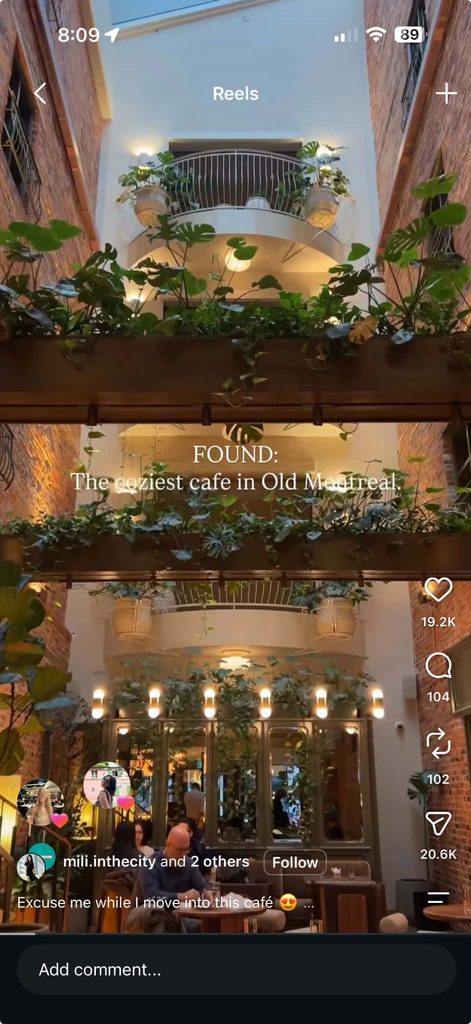
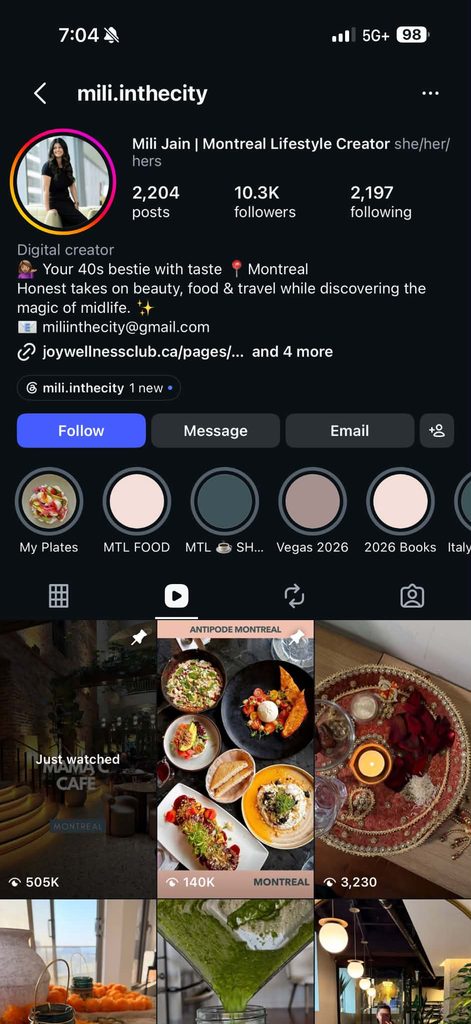
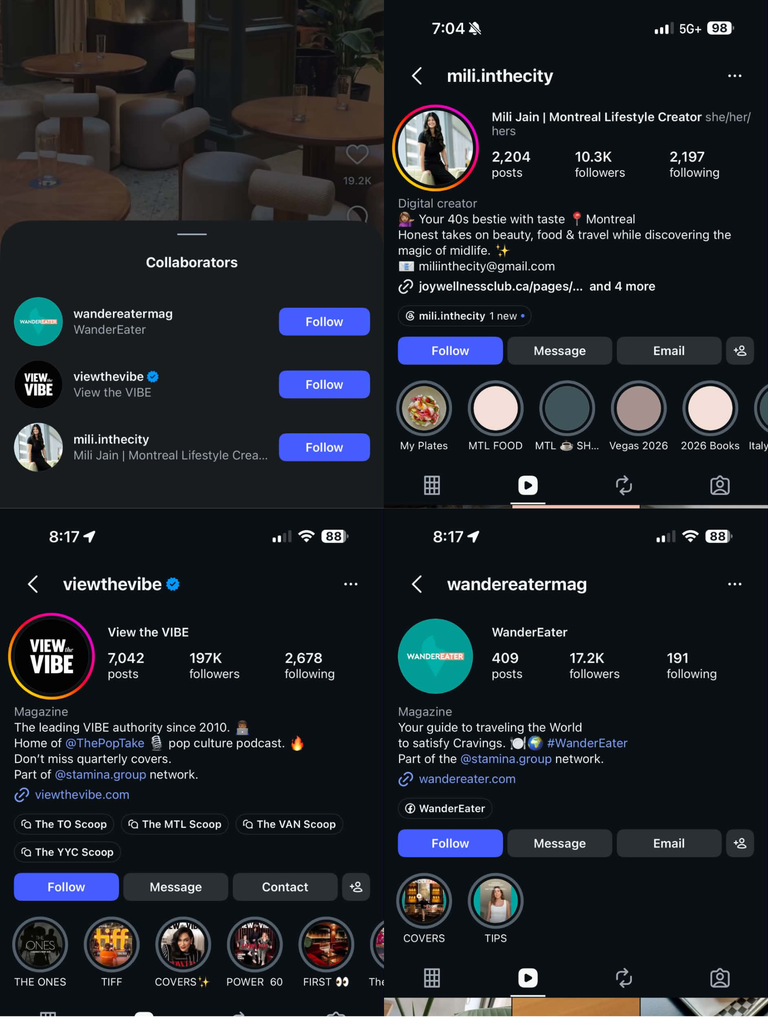
If you pay close attention, you can find out that this Instagram post was a collaboration between 3 different accounts, not by the small creator / influencer only (Mili Jain).
You quickly find out that Mili’s followers (10.3k) only represent about 4.6% of the possible reach, whereas the other 2 accounts (197k (macro-influencer) and 17.2k) have 20.8 times that amount combined.
Always make sure to check all the information available in front of you. Find out where the post got the most reach & the most attention.
Ask the 3 collaborators for their data to make a clear assessment.
Which method should you choose?
Each method is a trade-off between time and money. Here is how they compare for a small business.
| Method | Cost | Time needed | Best for |
|---|---|---|---|
| Own customers and followers | Free | Low | A first campaign with concrete fans |
| Hashtags and location tags | Free | High | Local businesses |
| Instagram creator marketplace | Included in Meta’s business tools | Medium | Brands that want to run ads on Instagram |
| TikTok One | Included in TikTok’s ad tools | Medium | Brands that want to run TikTok campaigns |
| Competitor research | Free | Medium | Finding creators who already do brand deals |
| Paid tools or agencies | Monthly fee or commission | Low | Bigger or repeated campaigns (also for bigger companies) |
How do you check a micro-influencer before signing with them?
Make sure that their likes and comments are made by real accounts, that their followers look like your clientele type, that your product fits the content they already do, and that they already label their sponsored posts accordingly.
- Ask for the data & insights of their posts. Instagram, for example, will tell you all about the demographics, when the post peaked, which type of audience saw it most and many more.
- Read the comments. Real comments usually look like conversations, questions or really just a basic funny comment. You can be suspicious of bots or bought followers when there are lots of short comments like “Nice!” or only emojis. These comments often come from the same accounts.
- Check that your product fits their content. Breves et al. (2019) found that when the product matches what an Instagram influencer usually talks about, people see the influencer as more knowledgeable and trustworthy, and they also like the brand more.
- Look at their past sponsored posts. It is important to check whether they clearly label them with #Ad. In Canada, brands are also responsible for this, and the Competition Bureau has already warned brands about it (Competition Bureau, 2019).
- Make sure their values match yours. Finally, scroll back a few months to look for controversial posts or a tone that does not fit your brand.
Why does checking matter more than follower count?
In my opinion, the number of followers is the easiest thing to look at, but it is also the easiest thing to fake or to misread. What really matters is the relationship between the creator and their community.
My #mtlspots example shows this well. At first, the post looked like a big success for one small creator. However, when I looked closer, Mili Jain’s followers represented only about 4.6% of the possible reach, and most of the attention actually came from the two other accounts. A business that only looked at the likes would have paid this creator for results she did not really bring.
This is why I recommend that a small business focus on three steps before signing: asking for the data, reading the comments and checking where the audience lives. Then, it should start with only one paid post before offering a longer partnership. Finally, in a small market like Quebec, where the same creators often work with many local brands, starting carefully also protects the business’s reputation.
Q&A – Micro-Influencers
Two to four is usually enough for a first test. You can compare results without spending too much time managing them.
Often, yes. It can mean the followers are fake or inactive, or that the audience has lost interest.
Yes. It is normal to ask for screenshots of where their followers live, their age range and their recent reach. Serious creators expect it and will give it to you.
Paid tools can estimate how many followers look suspicious, but reading the comments and checking follower growth yourself is still important. Checking yourself is the better source of truth.
Yes, but you should evaluate your own account the same way: check your engagement, your comments and where your followers live, to make sure it could really work.
References
Breves, P. L., Liebers, N., Abt, M., & Kunze, A. (2019). The perceived fit between Instagram influencers and the endorsed brand. https://doi.org/10.2501/JAR-2019-030
Competition Bureau Canada. (2019). Influencer marketing: Businesses and influencers must be transparent when advertising on social media. https://www.canada.ca/en/competition-bureau/news/2019/12/influencer-marketing-businesses-and-influencers-must-be-transparent-when-advertising-on-social-media.html
Meta. (2024). Creator marketplace for brands and creators to collaborate on Instagram. https://about.fb.com/news/2024/02/creator-marketplace-for-brands-and-creators-to-collaborate-on-instagram
TikTok. (2026). TikTok One: Your all-in-one creative platform for successful creator marketing. https://ads.tiktok.com/business/en-US/blog/tiktok-one-creative-platform
Wilson, K. (2019). Fake social media influencers will cost companies $1.3 billion in 2019. https://www.straight.com/tech/1279171/fake-social-media-influencers-will-cost-companies-13-billion-2019